The case for solar equity has never been stronger. Over the past two years, a wave of peer-reviewed research has confirmed what community-focused organizations have long understood: solar energy isn’t just an environmental tool. For under-resourced communities, it’s an economic lifeline — and access to it is deeply unequal.
The research landscape
In December 2023, Lawrence Berkeley National Laboratory published a study on how solar adoption spreads through communities — what researchers call “peer influence.” The key finding: low-income households are most strongly influenced by other low-income households. Seeing a neighbor, a familiar institution, or a trusted community anchor adopt solar is far more compelling than any marketing campaign.
But the study also identified the problem. Peer influence can prompt interest — it can’t remove the financial barriers that block access. Up-front costs, credit requirements, financing complexity, and homeownership status all create walls that good intentions and even government incentives haven’t fully dismantled. The research published since has made the stakes even clearer.
A March 2025 study in Nature Energy — one of the most rigorous peer-reviewed science journals in the world — evaluated solar’s effect on energy insecurity among low- and moderate-income households at a national scale. The findings were significant: solar adoption reduced energy insecurity across five separate measures. Households were more likely to pay their bills, less likely to face utility disconnection, and less likely to sacrifice spending on food or medicine to cover energy costs. The benefits, researchers noted, even “spilled over” to help households manage other bills beyond electricity.
A companion study published in Nature Communications in 2024 put numbers to the burden. Before solar, the median energy burden for low-income households — the share of income going to electricity — was 7.7%. After solar adoption, it fell to 6.2%. And the share of low-income households facing high or severe energy burden dropped from 67% to 52%. These aren’t marginal shifts. They represent a meaningful change in household stability.
Why nonprofits are the key
The Columbia University research published in Frontiers in Energy Research points to something that gets at the heart of Everybody Solar’s model. Community-based organizations — local nonprofits, churches, health clinics — are uniquely positioned to drive solar adoption in the communities they serve. They carry trust that solar companies and government programs often don’t. When they go solar, it’s visible, credible, and contagious in the best sense of the word.
The problem is that nonprofits face the same structural barriers as everyone else — and often more. They can’t use traditional tax credits. They operate on thin margins. Their rooftops represent deferred maintenance and limited capital. “Free solar” sounds too good to be true, which means the first job is always trust-building.
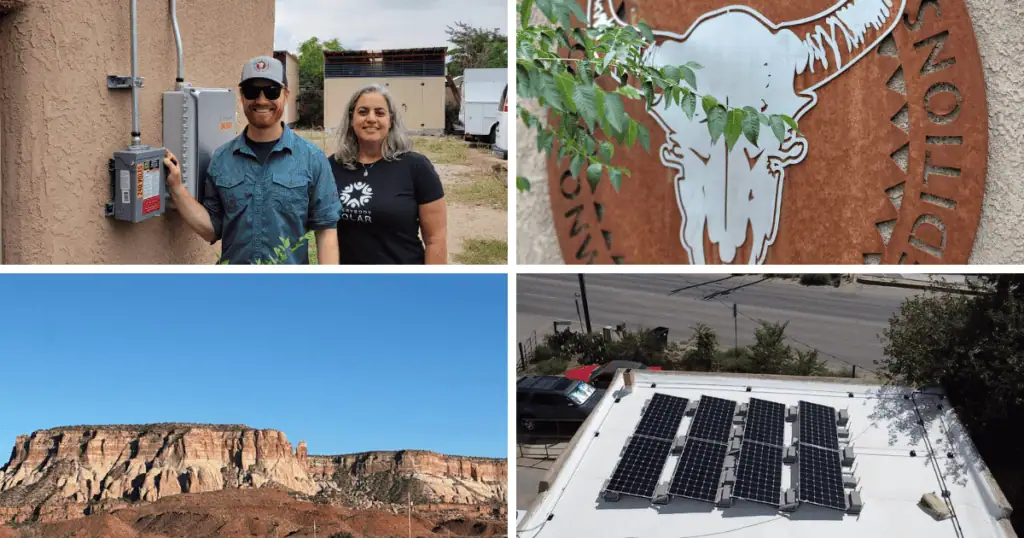
This is exactly the territory Everybody Solar operates in. We provide solar installations to nonprofits at no cost and no debt — the organization owns nothing, owes nothing, and saves immediately. That freed-up budget goes back into programs. And the visible presence of solar panels on a trusted community institution does something the science now confirms: it shifts the conversation about what’s possible.
What this means in practice
Every Everybody Solar installation is a proof point: that solar works for organizations serving everyone, that the model is real, and that each project may ripple outward in ways we can’t fully measure. The research on peer influence tells us that visibility matters — that a nonprofit with panels on its roof sends a signal to the whole community that this is possible here, for us.
The evidence is clear. The need is urgent. And we’re just getting started.
by Myriam Scally